 Thaka.Ai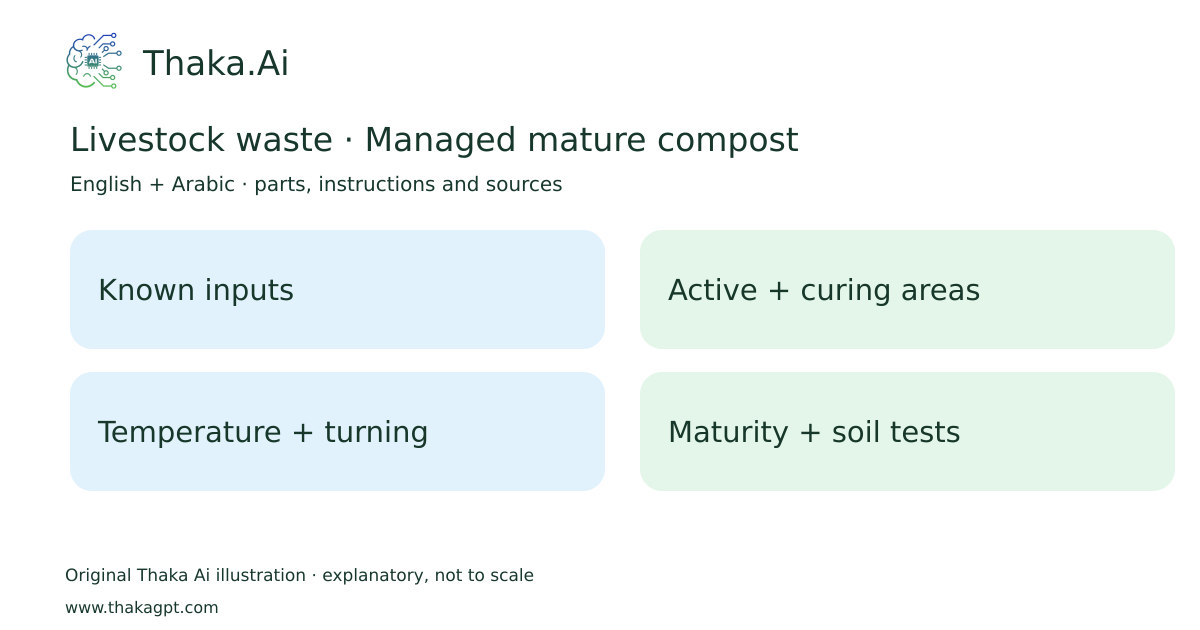
Reviewed 17 October 2026 · schematic not to scale
Convert manure and clean bedding into a managed soil amendment with separate active and curing areas.
- 1Known manure + clean dry carbon material
- 2Active aerated pile; probe several locations
- 3Separate curing pile; no new manure
- 4Protected pad, runoff control and batch records
Site and operating requirements
- Separate waste from feed and drinking water. Record input history, temperature, moisture, runoff and compost quality.
Tools and measuring equipment
- Dedicated gloves, labelled containers, thermometer, moisture checks, cleaning tools and a batch log.
Output and operating conditions
Mature compost for a soil-test-based application plan; nutrient content and pathogen reduction must be verified, not inferred from a warm pile.
OSU small-farm example: roughly 1.22–1.83 m high × 0.91–1.52 m wide, length to suit. These are compost-pile dimensions, not a structural wall design.Parts, quantities and dimensions
| Part | Quantity | Specification / dimensions |
|---|---|---|
| Protected processing pad | 2 zones | Active and curing zones with runoff containment, access for safe turning, separation from feed, wells, drainage and children. Check local siting requirements. |
| Manure and carbon-rich bedding | weighed batch | Record species, medications, bedding and hay/herbicide history. Add clean dry leaves/straw/wood shavings as needed for porosity and moisture. No plastic or carcasses. |
| Tools and records | 1 set | Long-probe compost thermometer, gloves, dedicated fork/tools, water control and a temperature/turning log. Use machinery only with training. |
Preparation and component checks
- Read the complete linked method, mark its edition, and create a measured component list and a labelled sketch before starting. Keep experimental changes separate from the published procedure.
- Prepare the work area and inspect every component. Run the lowest-risk dry or unpowered check before water, heat, moving parts or crop material are introduced.
Procedure
- 1
Obtain manure and bedding history. Keep contaminated or unknown inputs separate and arrange disposal/advice.
- 2
Choose a locally compliant pad, prevent stormwater entering the pile and capture drainage; do not direct it to animal water or irrigation tanks.
- 3
Mix manure with dry porous carbon material. Moisten evenly: a squeezed handful should feel damp with only a few drops, not run water.
- 4
Build the accessible pile and insert a long probe at several depths/locations. Record temperatures daily during active heating.
- 5
Turn to move outer material inward and restore air and moisture. Keep dated records; one hot core reading does not mean the whole batch was treated.
- 6
For a verified sanitation claim, use an approved process with the applicable time, temperature, turning and validation requirements. Do not combine schedules from different manuals.
- 7
Move to the curing area after active processing. Keep new manure out; cure until stable and recheck after remixing.
- 8
Test maturity, salts and nutrients; check herbicide carryover. Apply only at an agronomic rate and keep records of crop, area, mass and date.
Safety and inspection
Use local waste, food-safety and agricultural rules. Raw manure needs separate harvest-interval controls; composting and digestion do not automatically make waste safe for edible crops.
Verify the result
US FDA technical reference: turned aerobic compost ≥55°C for 15 days with ≥5 turns, then curing; static aerobic process ≥55°C for 3 consecutive days plus curing. These examples are not Kuwait certification or proof that your batch complies.
Measurement log
- Date, source materials, measured dimensions, inputs, weather/temperature, care, pests/odour, test results and output. Keep batch and location labels.
Maintenance and repeat checks
- Check moisture, odour, temperature, pests and runoff after turning and rain. Sour or wet piles need better air and dry bulking material.
- Do not feed compost, manure, digestate or leachate to livestock or birds. Mature appearance does not remove herbicide residues.
Troubleshooting
- Unexpected decline, pests, odour, poor growth or animal distress
- Pause the affected activity, separate suspect material and check the guide’s moisture, heat, hygiene, drainage and care requirements. Get a qualified diagnosis before treatment or reuse.