 Thaka.Ai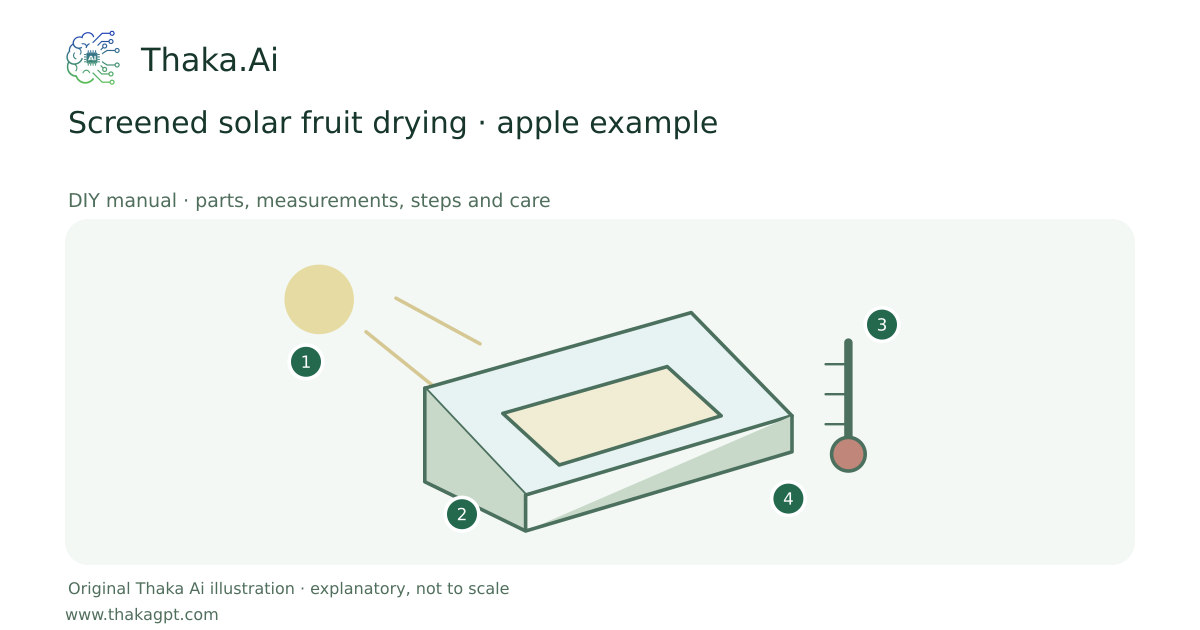
Reviewed 17 October 2026 · schematic not to scale
Prepare a small screened drying rack for suitable fruit in reliably hot dry weather, with a controlled dehydrator as backup.
- 1Clean suitable produce and preparation
- 2Protected food-grade drying surface
- 3Monitor temperature, airflow and drying endpoint
- 4Condition, inspect and package as directed
Site and operating requirements
- Identify crop, season, water quality, soil/medium and local heat. Measure materials before cutting and confirm support and drainage.
Tools and measuring equipment
- Knife, board, thermometer and humidity meter
- Food scale and clean storage boxes
Output and operating conditions
Sun drying fruit needs about ≥29°C and relative humidity <60%. Slice apples uniformly about 6 mm; solar time is weather-dependent.
Food-preservation principles, not a universal recipe for all foods. A 600 ×400 mm tray is an original small-batch layout example.Parts, quantities and dimensions
| Part | Quantity | Specification / dimensions |
|---|---|---|
| Raised food-contact drying tray | 1 | Original example 600 ×400 mm; nonreactive washable mesh with clean support, not copper or unknown coated metal. |
| Clean insect cover and rack | 1 set | Fine cover held clear of the fruit; airflow above and below and protection from birds and dust. |
| Hygienic preparation and storage kit | 1 set | Knife, board, safe water, measured pretreatment and dry food-contact plastic storage boxes. |
| Thermometer, humidity meter and backup dryer | 1 set | Use actual weather measurements and a controlled food dehydrator when outdoor conditions fail. |
Preparation and component checks
- Confirm fruit-specific preparation and drying guidance.
- Have controlled drying and freezer capacity available before cutting fruit.
Procedure
- 1
Measure weather and choose a clean protected drying site; postpone if humidity, dust or rain prevents reliable drying.
- 2
Wash hands and equipment; choose sound apples and wash under clean running water, not detergent.
- 3
Remove the core and slice apples uniformly about 6 mm. Soak 10 minutes in equal parts bottled lemon juice and water; drain without rinsing.
- 4
Spread one layer without overlap, fit the insect cover and monitor weather, airflow and drying progress.
- 5
Bring trays under clean dry shelter at night; finish in a controlled dehydrator if weather becomes unsuitable.
- 6
Cool and test dryness, then condition in clean covered containers for 7–10 days, shaking daily; redry if condensation appears and discard mould.
- 7
Before permanent packaging, seal dried fruit in freezer-safe boxes and freeze at −18°C or colder for at least 48 hours to kill insects and eggs; let the sealed box warm before opening.
Ready-to-use checklist
- No wet centres, contamination or mould.
- Conditioning and insect treatment finished; dry packaging is labelled.
Safety and inspection
Do not sun-dry meat, fish or dairy with this guide. Drying does not sterilise food. Reject mouldy fruit; use clean food-contact screens rather than unknown hardware mesh.
Verify the result
Cool test pieces: apples should be pliable without visible or squeezable moisture. Condition dried fruit and redry condensation before storage.
Measurement log
- Fruit type, slice size, pretreatment and weather.
- Dryness tests, conditioning checks and storage date.
Maintenance and repeat checks
- Wash and dry trays, screens and tools after every batch.
- Package conditioned dry fruit against moisture and inspect during storage; record the batch and method.
Troubleshooting
- Unexpected decline, pests, odour, poor growth or animal distress
- Pause the affected activity, separate suspect material and check the guide’s moisture, heat, hygiene, drainage and care requirements. Get a qualified diagnosis before treatment or reuse.