 Thaka.Ai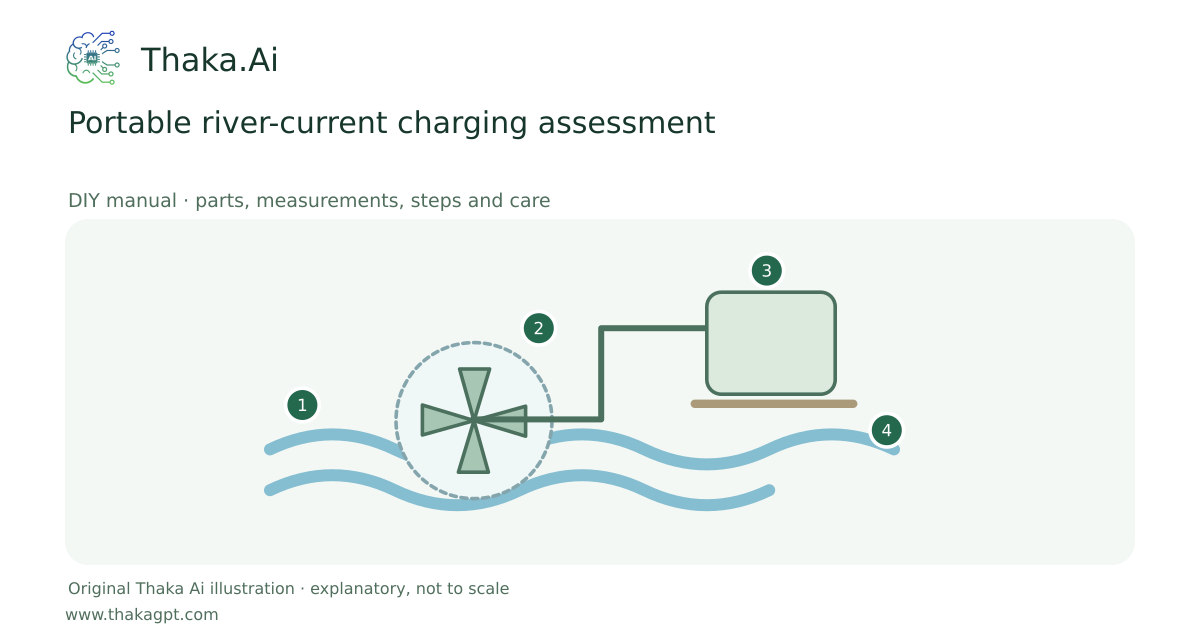
Reviewed 17 October 2026 · schematic not to scale
A guarded complete hydrokinetic device can extract energy from naturally flowing water at a permitted site. It is unsuitable for dry wadis, stagnant water or pumped recirculation.
- 1Measure permitted safe flow and site conditions
- 2Guarded matched water device
- 3Dry control and protected low-voltage storage
- 4Measure loaded output and safe retrieval
Site and operating requirements
- Survey net head, usable seasonal flow, flood level, debris and legal access. Select a design for that measured resource.
- Obtain complete shaft, bearing, mounting, guard and electrical drawings. A photograph is not a tolerance or load specification.
Tools and measuring equipment
- Safe flow survey tools and DC energy logger
Output and operating conditions
Example: 0.04 m² swept area in 1 m/s water contains 20 W of kinetic flux. With an assumed combined extraction/delivery factor 0.20, 4 W would reach the load; at 2 m/s the same assumption gives 32 W.
Original arithmetic using 0.5 × water density × area × velocity³. These are conditional examples, not measured output or a universal turbine efficiency.Parts, quantities and dimensions
| Part | Quantity | Specification / dimensions |
|---|---|---|
| Complete guarded hydrokinetic unit | 1 | Documented speed/depth range and guarded rotor. |
| Matched regulator and battery | 1 set | Protected low-voltage input and correct electrical isolation from water. |
| Designed tether and retrieval system | 1 set | Rated for the unit and site; does not obstruct navigation or paths. |
| Flow and energy measurement | 1 set | Safe survey tools and logger appropriate for the site. |
Preparation and component checks
- Check water access and environmental permission.
- Prepare retrieval without hazardous wading.
Procedure
- 1
Confirm flowing-water access, permission and a safe retrieval route.
- 2
Survey speed, depth, debris and seasonal flow without dangerous wading.
- 3
Compare the complete unit curve with the measured resource.
- 4
Have tethers, guarding and electrical separation checked competently.
- 5
Deploy only by the equipment-approved procedure from a safe position.
- 6
Log energy and retrieve before storms, debris buildup or rising water.
Ready-to-use checklist
- Retrieval and guarding are verified.
- There is no obstruction to people or aquatic life.
Safety and inspection
No wading in fast water, unsecured ropes across paths, fish barriers or deployment during rising flow. Obtain site and environmental permission.
Verify the result
Use a complete device power curve and a competent safe flow survey. Log delivered Wh at the actual depth and retrieve without entering hazardous water.
Measurement log
- Velocity, depth and delivered Wh
- Debris and water-level changes
Maintenance and repeat checks
- Inspect the tether, guard and cable after each retrieval.
- Clean and dry the unit and avoid transporting aquatic organisms between waterways.
Troubleshooting
- No output, abnormal heat, noise, vibration or leaks
- Stop and isolate first. Check the documented input, load compatibility, alignment and connections; keep guards fitted and refer specialist systems to their installer.