 Thaka.Ai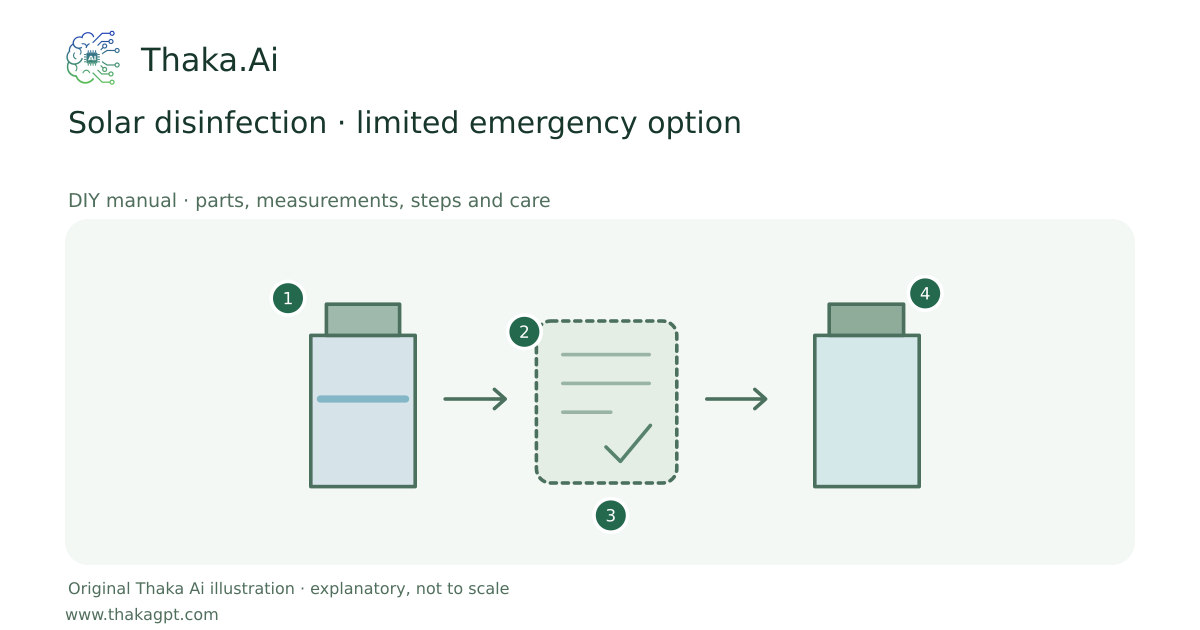
Reviewed 17 October 2026 · schematic not to scale
Use sunlight as a limited emergency germ-reduction option when dependable treatment is unavailable.
- 1Assess raw water; avoid chemical/salt contamination
- 2One documented treatment sequence
- 3Observe full time, clarity and equipment limits
- 4Protected clean storage and a backup supply
Site and operating requirements
- Identify intended use and likely biological, chemical and salt contamination before choosing treatment. Obtain suitable water testing.
- Keep raw-water and treated-water containers, tools and hands separate. Use clean covered storage.
Tools and measuring equipment
- Time and weather log
- Clean clarification cloth
Output and operating conditions
Clear water in clear plastic bottles: 6 hours of sun in sunny conditions or 2 days when cloudy.
Public-health emergency guidance; not a desalination method or a promise for all climates. No guaranteed daily litres.Parts, quantities and dimensions
| Part | Quantity | Specification / dimensions |
|---|---|---|
| Clean clear plastic bottles | 2 or more | Use intact transparent food/drink bottles with caps; avoid scratched, coloured or opaque vessels. |
| Stable sun-exposed surface | 1 | Lay bottles horizontally where no shade crosses them; prevent rolling or theft. |
| Cloth, label and timer | 1 set | Clarification cloth is a sediment prefilter, not a disinfectant. Keep treated batches identifiable. |
Preparation and component checks
- Check that the water is clear and source hazards are acceptable.
- Reserve safe water for the entire waiting period.
Procedure
- 1
Choose fresh water without suspected chemical contamination; plan a safer backup supply.
- 2
Wash the bottles and caps; discard any container with an unknown or chemical-use history.
- 3
Let cloudy water settle and filter sediment through clean cloth; use only clear water for exposure.
- 4
Fill, cap and lay bottles on their sides in full sun; write the start time.
- 5
Maintain the full sunny or cloudy exposure period; relocate only if needed to avoid shade.
- 6
Keep water in the capped treatment bottle until use; do not mix with untreated water.
Ready-to-use checklist
- Required exposure completed without unresolved doubts.
- Bottles remain capped and clearly marked.
Safety and inspection
Turbidity blocks light. Do not use chemically contaminated water or assume a blue bottle, UV LED or sunlight through a window is equivalent. Carry safe water for deserts.
Verify the result
Record actual exposure and weather. If clarity, exposure or bottle suitability is doubtful, use another verified treatment.
Measurement log
- Start, finish, cloud cover and interruptions.
- Bottle condition and source location.
Maintenance and repeat checks
- Replace cloudy or damaged bottles and keep caps clean.
- Reassess after weather changes; an uncompleted exposure is not ready water.
Troubleshooting
- Flow/cycle outside the documented range or failed test
- Do not use the output for drinking. Recheck raw-water quality, batch volume, seals/media/device status and the complete source instructions. Retest after correction.