 Thaka.Ai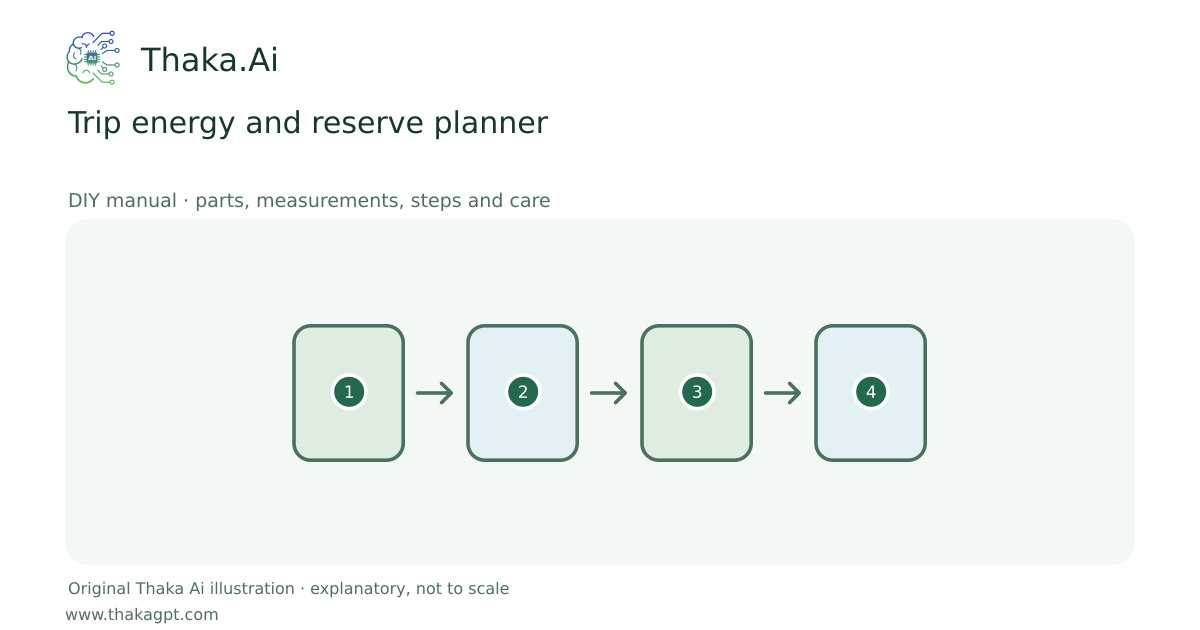
Reviewed 17 October 2026 · schematic not to scale
Measure the electronics you actually carry before choosing solar or batteries. Separate communications and navigation from optional loads.
- 1Measure the trip or job requirements
- 2Choose compatible existing equipment
- 3Dry-run and record actual performance
- 4Pack a backup and clear care instructions
Site and operating requirements
- Identify the external energy input and the maximum permitted rotor, bearing and spring limits from the selected kit.
- Use a stable dry bench, guards and a clear stop procedure. Do not increase speed to chase a voltage reading.
Tools and measuring equipment
- USB meter and calculator
Output and operating conditions
Example: phone 12 Wh + light 2 W × 3 h + navigation 4 Wh = 22 Wh/day. Two days need 44 Wh delivered; at an assumed 80% delivery efficiency that is 55 Wh nominal, before reserve.
Original arithmetic using E = power × time. The 80% factor is a planning assumption, not a guaranteed battery efficiency.Parts, quantities and dimensions
| Part | Quantity | Specification / dimensions |
|---|---|---|
| USB energy meter | 1 | Supports the voltage and current of the devices being measured. |
| Trip worksheet | 1 | Columns: device, watts or Wh, hours, days and reserve. |
| Existing charging cables | 1 set | Use the same cables planned for the trip. |
Preparation and component checks
- Charge all devices consistently before measuring.
- Write down the number of days without reliable charging.
Procedure
- 1
List devices and mark essential items.
- 2
Read Wh from battery labels; do not compare mAh at different voltages.
- 3
Measure a full normal charge with the meter.
- 4
Multiply each daily load by trip days.
- 5
Account for conversion losses and a separately chosen weather reserve.
- 6
Test all essential devices from the packed supply before departure.
Ready-to-use checklist
- Every essential device has a tested cable.
- Emergency energy is accounted for separately.
Safety and inspection
Keep a separately charged emergency supply; a solar forecast is not a rescue or communications guarantee.
Verify the result
Run a representative day at home and compare measured input/output Wh with the list.
Measurement log
- Daily delivered Wh and reserve
- Measured charging losses
Maintenance and repeat checks
- Update the plan when any device or season changes.
- Record actual consumption after each trip to improve the next estimate.
Troubleshooting
- No output, abnormal heat, noise, vibration or leaks
- Stop and isolate first. Check the documented input, load compatibility, alignment and connections; keep guards fitted and refer specialist systems to their installer.