 Thaka.Ai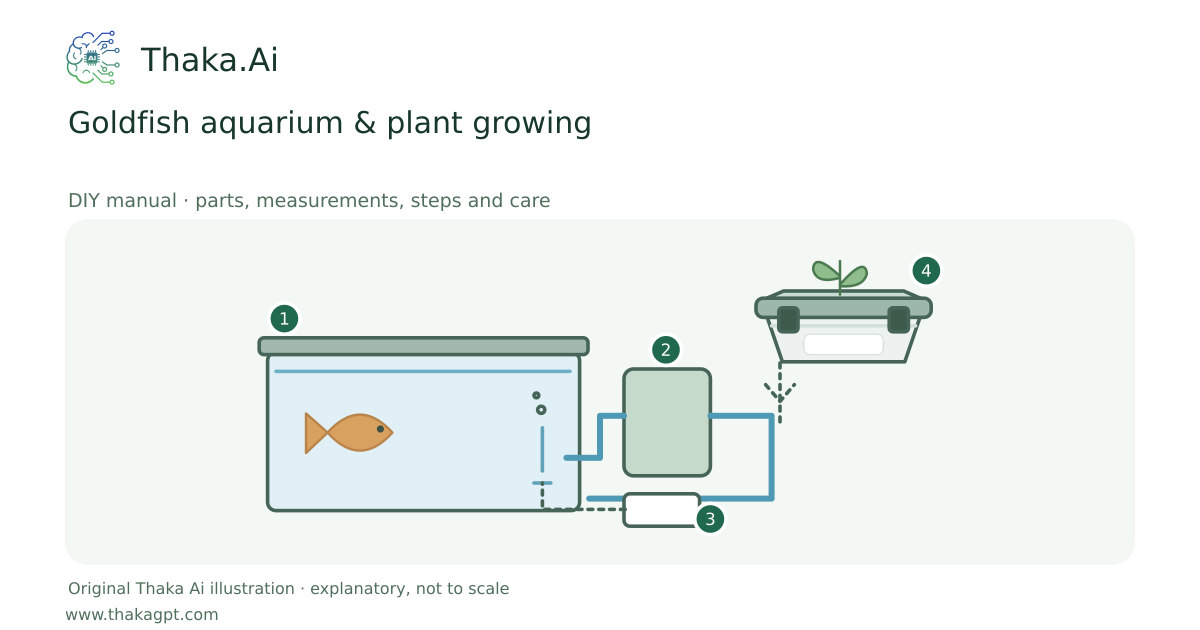
Reviewed 17 October 2026 · schematic not to scale
Build a cared-for indoor goldfish aquarium, with an optional independently supported plastic plant-growing box. Fish welfare and filtration come first.
- 1Goldfish aquarium with secure ventilated cover
- 2Dedicated mechanical and cycled biological filter
- 3Independent air supply, tests and power backup
- 4Optional separate plastic grow box; no fertiliser in fish water
Site and operating requirements
- Identify crop, season, water quality, soil/medium and local heat. Measure materials before cutting and confirm support and drainage.
Tools and measuring equipment
- Tape, level, marked water measure, thermometer, water test kit, siphon and dedicated clean plastic maintenance boxes.
Output and operating conditions
A monitored aquarium and a separate plant-care route. Fish water is not a complete plant fertiliser and plants do not replace aquarium filtration.
For fancy adult goldfish, OATA gives at least 100 L for the first adult plus 50 L per additional adult, with suitable dimensions and filtration. RSPCA also relates tank dimensions to adult body length: at least 4× long, 2× wide and 3× high; active slim varieties need more swimming length. A supplier must approve the actual adult variety, usable volume and fish count.Parts, quantities and dimensions
| Part | Quantity | Specification / dimensions |
|---|---|---|
| Purpose-built aquarium, ventilated cover and rated stand | 1 set | Buy the approved adult-size aquarium. Record internal length × width × working water depth in cm; divide their product by 1000 for gross litres, then measure actual fill after substrate/equipment displacement. No bowl or homemade glass-thickness/stand recipe. |
| Mechanical/biological filter and air supply | 1 set | Match to goldfish waste load and the actual tank. Use gentle distributed current for fancy fish, screened intakes, an air pump/stone, check valve where specified and backup aeration. Fit equipment by its manual. |
| Test and water-care kit | 1 set | Thermometer; ammonia, nitrite, nitrate, pH and hardness tests; conditioner that treats the supply’s chlorine/chloramine; siphon and dedicated clean maintenance boxes. OATA fancy-goldfish optimal temperature 15–23°C; pH 6.5–8.5; ammonia and nitrite zero. |
| Species-appropriate food and plant option | 1 set | Specialised goldfish food; sinking pellets may suit fancy types. The optional grow box is clean crop-compatible plastic on its own support; keep plant fertiliser/pesticide and fish medicines out of any shared loop. |
Preparation and component checks
- Approve usable volume, adult fish needs and loaded stand capacity before purchase; read every equipment manual.
- Keep the fish and plant designs separate on paper first; mark where fertiliser, medicine or contaminated water could cross.
Procedure
- 1
Choose the adult goldfish variety first and have a qualified aquarium supplier confirm the tank, filtration, stocking and long-term space. Do not mix fast common fish with slow fancy fish by default.
- 2
Put the aquarium on its rated level stand indoors, away from sunlight, heat and vibration. Measure summer water temperature before buying fish; arrange appropriate cooling if needed in MENA.
- 3
Fit rounded aquarium-safe decoration, filter, aeration and lid by their manuals. Leak-test and mark the actual working water level. Keep electrical connections dry with drip loops and locally approved protection.
- 4
Condition the water and cycle the biological filter WITHOUT fish using a suitable aquarium maturation product and its measured-volume instructions. Record tests; elapsed weeks alone do not prove readiness.
- 5
Introduce fish gradually only after the supplier confirms readiness and ammonia/nitrite remain zero under the chosen cycling procedure. Acclimatise by the supplier’s instructions and monitor closely.
- 6
Feed small portions of specialised food, remove uneaten food and observe every fish. Follow the actual feed and supplier advice rather than feeding for plant nutrient demand.
- 7
Test at least weekly, more often during startup or problems. OATA recommends a 25% partial change weekly with conditioned temperature-matched water; 200 L of ACTUAL water × 25% = 50 L. Rinse filter media lightly in removed tank water.
- 8
Begin the plant option with suitable removed maintenance water on ornamental soil plants. An optional return loop needs the separate aquaponics design: solids removal, biofilter, oxygen, overflow, isolation and compatible water chemistry. Never pour ordinary hydroponic fertiliser into the aquarium.
Ready-to-use checklist
- Approved adult-size tank and fish count; no leaks; cycled filter; ammonia/nitrite zero; stable suitable temperature; safe aeration and an emergency plan.
- Resolve any missing critical material, support or operating specification before starting.
Safety and inspection
Water alone in a 200 L working aquarium weighs about 200 kg before glass and equipment. Use a rated stand and child-safe ventilated cover. A recirculating plant loop requires aquaculture review before connecting; no sacrificial fish for cycling.
Verify the result
Approved adult-size tank and fish count; no leaks; cycled filter; ammonia/nitrite zero; stable suitable temperature; safe aeration and an emergency plan.
Measurement log
- Date, actual dimensions/working volume, product labels, readings, actions and results. Keep before-and-after photographs.
Maintenance and repeat checks
- Daily: check behaviour, breathing, temperature, filter flow, aeration and food. If fish gasp or ammonia/nitrite rise, test immediately and contact the supplier or aquatic veterinarian; follow their water-change and aeration advice.
- Weekly: log water tests and measured changes; inspect intakes and media. Never wash with soap, rinse all bio-media under chlorinated tap water, or release fish into natural waterways. Keep backup aeration and a relocation plan.
Troubleshooting
- Gasping, abnormal swimming, rising ammonia/nitrite or stalled filtration
- Check temperature, water tests and aeration immediately. Restore safe air/flow and contact the aquarium supplier or aquatic veterinarian for species-appropriate water-change and treatment advice; isolate plant chemicals and avoid blind medicine dosing.
- Plant growth is poor while fish water looks clear
- Measure the plant system separately. Fish effluent may not supply every required nutrient; use a decoupled plant design and qualified advice rather than adding ordinary fertiliser to fish water.